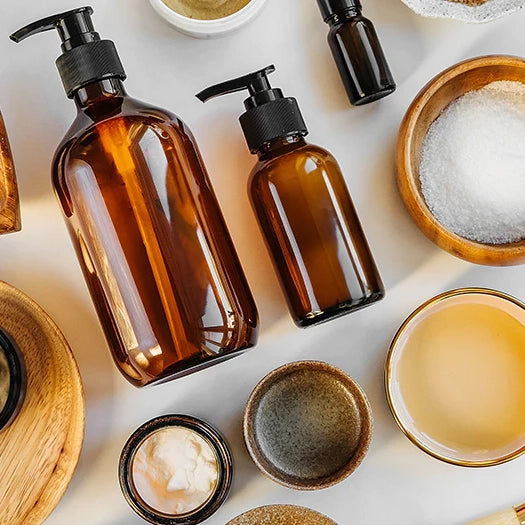


Learn how to make a vegan-friendly rosehip cleansing balm with grapeseed oil, shea butter and candelilla wax. Discover how cleansing balms work and the benefits of each ingredient.
A good cleansing balm can turn your everyday skincare routine into a relaxing ritual.
Full of nourishing oils, a cleansing balm will melt as it's massaged into the skin to help lift away makeup, sunscreen and the oils and impurities that accumulate throughout the day.
Unlike a simple blend of oils and waxes, this DIY Rosehip Cleansing Balm contains emulsifying wax which transforms it into a light milky cleanser that rinses away easily once water is added. The cleansing balm rinses easily from your face while leaving your natural moisture barrier intact, to leave your skin feeling clean, but soft, rather than excessively oily.
This formula combines lightweight grapeseed oil with rosehip oil, shea butter, vegan-friendly candelilla wax and vitamin E. It is particularly lovely for dry, mature or normal skin, but can be enjoyed by most skin types.
Jump to the Recipe
How to use your cleansing balm
What does each ingredient do?
Storage and shelf life
Do you need a preservative?
Important formulation notes
Where to buy the complete DIY Cleansing Balm Kit
What is a cleansing balm?
A cleansing balm is an oil-based facial cleanser that is solid or semi-solid at room temperature. When applied to the face, the warmth of your skin melts the balm into an oil.
Oil-based cleansers are particularly effective at loosening oil-soluble substances, including:
- Makeup
- Sunscreen
- Excess sebum
- Everyday grime
- Some long-wearing cosmetic products
After the balm has been massaged over the skin, a small amount of warm water is added. The emulsifying wax allows the oils and water to mix temporarily, creating a milky emulsion that can be rinsed or removed with a warm, damp face cloth.
This emulsifying action is what distinguishes an emulsifying cleansing balm from a plain facial oil. It provides the richness and slip of an oil cleanser while making the product easier to remove.
The benefits of cleansing with a balm
Cleansing balms clean the skin without relying on strong, high-foaming surfactants. Although foam can feel cleansing, a product does not need to produce bubbles to remove makeup and daily impurities effectively.
A well-formulated cleansing balm can:
- Dissolve makeup and sunscreen
- Cleanse without leaving the skin feeling tight or stripped
- Provide plenty of slip for a gentle facial massage
- Help soften the skin while cleansing
- Reduce the need for disposable makeup wipes
- Be stored in a reusable or recyclable container
Cleansing balms can also be useful as the first step in a double-cleansing routine. After removing the balm, you can follow with a gentle water-based cleanser if your skin needs a more thorough cleanse.
DIY Rosehip Cleansing Balm Recipe
This percentage-based formula can be used to make any quantity. For a simple 100-gram batch, each percentage is equal to the same number of grams.
| Ingredient | Percentage | Amount for 100 g | Purpose |
|---|---|---|---|
| Grapeseed oil | 60% | 60 g | Lightweight emollient and carrier oil |
| Rosehip oil | 9% | 9 g | Conditioning botanical oil |
| Shea butter | 15% | 15 g | Softening emollient |
| Candelilla wax | 6% | 6 g | Vegan-friendly structure and firmness |
| Emulsifying wax | 5% | 5 g | Helps the balm turn milky and rinse away |
| Cetyl alcohol | 3% | 3 g | Thickener, stabiliser and texture enhancer |
| Vitamin E oil | 1% | 1 g | Antioxidant |
| Essential oil, optional | 1% | 1 g | Fragrance |
| Total | 100% | 100 g |
Prefer a fragrance-free balm?
For a fragrance-free version, leave out the essential oil and increase the grapeseed oil from 60% to 61%. This ensures the formula still adds up to 100%.
A fragrance-free balm may be the more suitable choice for sensitive or reactive skin. If you do add an essential oil, check its dermal limit with your supplier and make sure it is appropriate for a rinse-off facial product.
Equipment
You will need:
- Digital scales accurate to at least 0.1 gram
- Heat-resistant glass jug or bowl
- Saucepan for creating a water bath
- Spoon or glass stirring rod
- Clean, dry cosmetic jar
- Isopropyl alcohol for sanitising equipment
- Thermometer, if available
Because this is a skincare product, it is important to begin with clean, sanitised equipment and a completely dry work area.
Method
- Clean and sanitise your work surface, equipment and container. Allow everything to dry completely before you begin.
- Weigh the grapeseed oil, shea butter, candelilla wax, emulsifying wax and cetyl alcohol into a heat-resistant container.
- Place the container into a gentle water bath. Heat slowly, stirring occasionally, until the waxes and shea butter have melted completely and the mixture is clear and uniform.
- Remove the container from the heat and allow the mixture to cool slightly while continuing to stir.
- Add the rosehip oil and mix thoroughly. Adding it after the main heating stage helps minimise the amount of heat to which this more oxidation-sensitive oil is exposed.
- When the mixture has cooled further but is still completely liquid, add the vitamin E oil and the optional essential oil. Stir well to distribute them evenly.
- Pour the balm into a clean, dry jar.
- Leave it undisturbed at room temperature until completely cool and set. Place the lid on the jar once the balm has cooled.
The final texture may continue to settle and firm over the following 24 hours.

How to use your cleansing balm
Begin with dry hands and a dry face.
Scoop out a small amount of balm using a clean, dry cosmetic spatula. Massage it gently over the face using circular movements, paying particular attention to areas with makeup or sunscreen.
Add a little warm water and continue massaging. The balm should turn into a light, milky emulsion.
Rinse well or remove it with a warm, damp face cloth. Avoid pulling or scrubbing the skin, particularly around the eyes.
If you wear heavy or waterproof eye makeup, check that every ingredient in your version is suitable for use around the eyes. Keep your eyes closed during cleansing and discontinue use if irritation occurs.
What does each ingredient do?
Candelilla wax
Candelilla wax is a hard plant-derived wax obtained from the leaves of the candelilla shrub. It provides structure, firmness and stability, helping turn the liquid oils into a solid balm.
It also gives the balm a smooth surface and contributes a subtle gloss. Because candelilla is a plant wax, it is a useful vegan-friendly alternative to beeswax.
Candelilla wax is harder than beeswax, so it is normally used at a lower concentration. In this formula, it helps create a balm that holds its shape but still melts when warmed against the skin.
Shea butter
Shea butter is a rich plant butter traditionally produced from the kernels of the African shea tree. As an emollient, it helps soften and smooth the skin.
It also gives the cleansing balm body and creaminess, balancing the harder texture contributed by the candelilla wax. Its rich skin feel makes the cleanser particularly appealing for dry or mature skin.
Although the balm is rinsed away, shea butter helps the skin feel comfortable and conditioned during and immediately after cleansing.
Grapeseed oil
Grapeseed oil is the main carrier oil in this recipe. It has a relatively light texture and provides excellent slip, allowing the balm to glide comfortably across the skin without the need for vigorous rubbing.
The oil contains a high proportion of linoleic acid, an omega-6 fatty acid found naturally in the skin’s surface lipids. Research into topical plant oils suggests its fatty-acid composition can influence its effects on the skin barrier, although the evidence varies between individual oils and formulations.
In this cleansing balm, grapeseed oil’s most important jobs are to dissolve oil-soluble makeup and sunscreen, provide massage slip and prevent the finished balm from feeling excessively heavy.
Rosehip oil
Rosehip oil is valued in skincare for its fatty-acid composition and naturally occurring antioxidant compounds. It is commonly included in products developed for dry, mature or uneven-looking skin.
Some research has explored rosehip-derived ingredients in relation to skin appearance and healing, but high-quality clinical evidence remains limited. It is therefore more accurate to describe rosehip oil as a conditioning and emollient ingredient rather than claiming that a rinse-off cleanser will treat scars, wrinkles or pigmentation.
Within this recipe, rosehip oil adds a nourishing skin feel and complements the lighter grapeseed oil. Because it can oxidise more readily than some carrier oils, store both the ingredient and finished balm away from heat and direct sunlight.
Emulsifying wax
Emulsifying wax is the ingredient that gives this formula its rinse-off quality.
Oil and water do not ordinarily mix. When water is added during cleansing, the emulsifying wax helps disperse the balm’s oils through the water. The balm becomes milky and can be rinsed away more readily, carrying loosened makeup, sunscreen and grime with it.
Without an emulsifier, a balm made from oils, butter and wax would leave a more noticeable oily film and might require repeated removal with a face cloth.
The INCI listed in this formula is Cetearyl Alcohol and Ceteareth-20. Emulsifying waxes are not all identical, so substituting a different variety may change the balm’s texture and rinse-off performance.
Cetyl alcohol
Despite its name, cetyl alcohol is not the same as ethanol or the drying alcohol sometimes found in toners and hand sanitisers. It is a long-chain fatty alcohol used in cosmetics as a thickener, emollient and texture enhancer.
Cetyl alcohol helps stabilise the balm and contributes a smooth, velvety glide. It can also make the product feel less waxy and improve the way it melts and spreads over the skin.
At 3%, it supports the structure of the balm without making it overly stiff.
Vitamin E oil
Vitamin E, listed as tocopherol, acts primarily as an antioxidant in this formula. It helps slow the oxidation of the plant oils, which can delay the development of rancid odours and changes in product quality.
Vitamin E is not a broad-spectrum preservative. It will not protect a product from bacteria, yeast or mould if water is introduced.
For this reason, always use dry hands or a clean, dry spatula to remove the balm from its jar, and do not allow water to collect inside the container. Cosmetic products can become contaminated when water or unclean fingers are introduced, so good hygiene remains important even with a water-free formula.
Does this cleansing balm need a preservative?
This is an anhydrous formula, meaning that no water is included when the balm is made. Microorganisms generally require available water to grow, so a freshly prepared, properly handled water-free balm presents a lower microbial risk than a lotion or cream containing water.
However, the product can still become contaminated during use—particularly if wet fingers are dipped into the jar. Keep the container away from splashing water, use a clean spatula and discard the balm if its appearance, texture or smell changes.
Vitamin E helps protect the oils from oxidation, but it does not replace a cosmetic preservative.
Storage and shelf life
Store the finished balm in a cool, dry place away from direct sunlight. Avoid leaving it in a hot bathroom or car, as higher temperatures may soften or melt the balm and accelerate the deterioration of its plant oils.
For a home-made batch that has not undergone stability or microbiological testing, it is sensible to make a modest quantity and use it within approximately three months. This is a practical home-use guide rather than a laboratory-verified expiry period.
Discard the product sooner if it develops an unusual smell, colour or texture.
Important formulation notes
- Always measure cosmetic ingredients by weight rather than volume.
- Patch test the finished balm before applying it to your entire face.
- Avoid introducing water into the jar.
- Do not substitute ingredients without expecting changes to the texture and performance.
- Check supplier documentation before using an essential oil on the face.
- Discontinue use if irritation occurs.
-
This recipe is intended for personal use and is not a substitute for professional medical advice or commercial cosmetic testing.
Want to make it without sourcing every ingredient?
If you would like to try making a cleansing balm without buying each ingredient separately, the nood mood Rosehip Cleanser DIY Skincare Kit contains the ingredients and instructions you need.
It is a simple way to experience the process of making your own skincare at home—and enjoy the satisfaction of knowing exactly what has gone into your cleanser.